

Employers investing in AI training are increasingly presented with bold claims: productivity gains, cost reductions and ROI. What’s far less clear is how many of those claims stand up to scrutiny, and how many rely on optimistic assumptions rather than verifiable evidence.
Here is what Corndel has learnt from measuring the impact of training across 40,000+ individuals and over 400 enterprise organisations. We explain what credible impact measurement looks like, what we've found since launching Corndel's AI Academy, and the questions every employer should be asking before they invest.
“Corndel’s methodology linked individual projects to business value and used a clear evaluation framework to isolate the effect of the programme from other influences. That gave us a credible basis for reporting a 126% return on learning investment."
1. Impact measurement should be a continuous evaluation journey
A common mistake in training evaluation is treating impact as a one-off event, perhaps as something captured through a single workplace project or a headline figure at the end of a training programme. In practice, the value of AI training will accumulate over time and as such, should be evaluated continuously to evidence sustained impact.
Individuals on effective training programmes will cycle repeatedly through acquiring new skills, applying them to real workplace challenges, and refining what works. Early, practical applications generate value quickly and as new ways of working become embedded in day-to-day practice, individual efficiency gains grow into sustained organisational returns, spreading across teams and functions.
This has a direct implication for how impact should be measured. Organisations that evaluate only through projects or only at the end miss early evidence that training is working, lose the opportunity to course-correct if it isn't, and risk attributing to the programme outcomes that would have happened anyway.
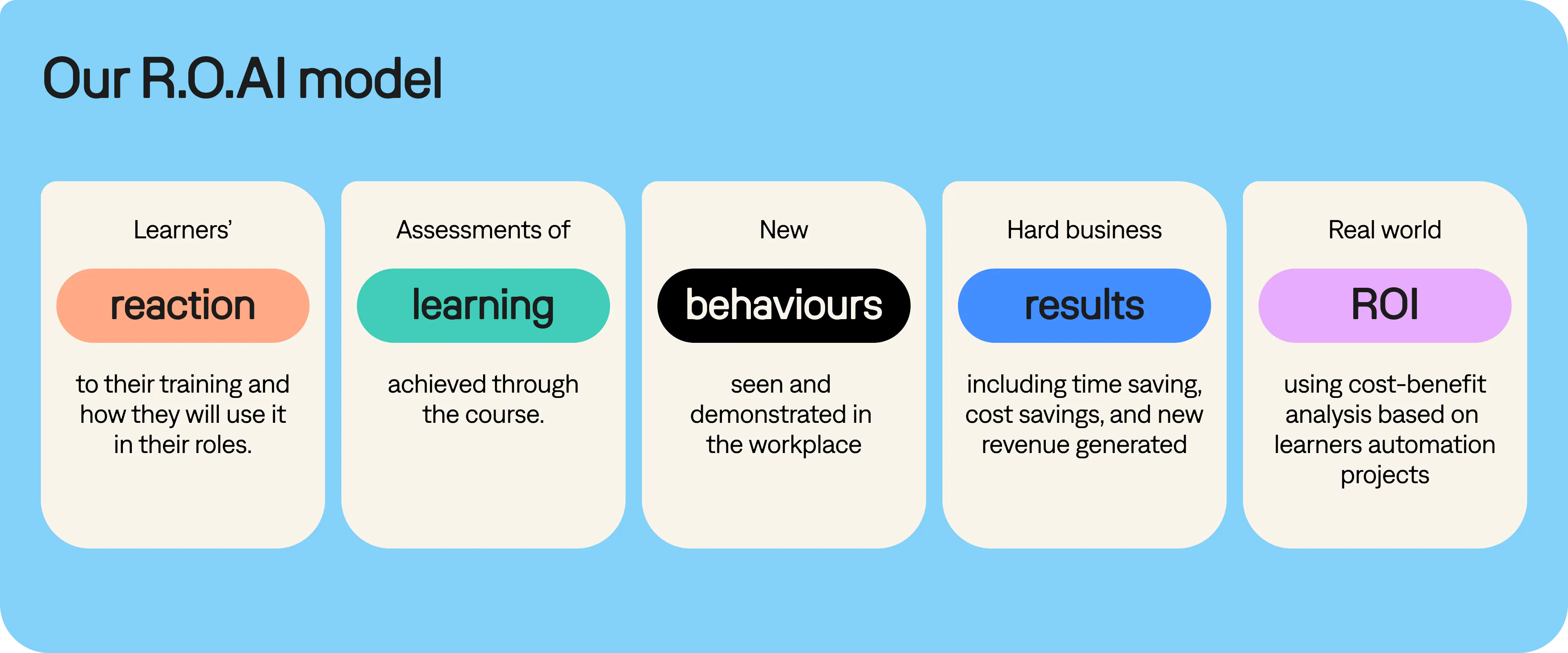
That's why Corndel measures impact across all five levels of the Phillips Learning Evaluation Model throughout our programmes – from the earliest weeks through to completion and beyond – capturing leading indicators of change, early evidence of business results, and sustained ROI.
"Chris applied automation skills to identify customers presenting elevated money laundering risk – a complex, data-intensive problem not viable using manual processes alone. This directly supported enhanced money laundering risk assessment, providing investigators and stakeholders with clearer visibility of higher-risk customers and enabling more targeted downstream activity. It demonstrated a tangible return from the apprenticeship, as the automation skills acquired were fundamental to delivering the work within acceptable timeframes and quality standard.”
2. Behind every ROI figure are people who have changed their behaviour
The most reliable leading signal that AI training is working is observable behaviour change in the workplace.
Every individual and every organisational context is different, and many of the most significant changes – stronger decision-making, better stakeholder communication, reduced cognitive load – do not reduce neatly to a single figure. Reporting only quantified results obscures the real breadth of what good AI training delivers and can mislead decision-makers into undervaluing programmes that are working.
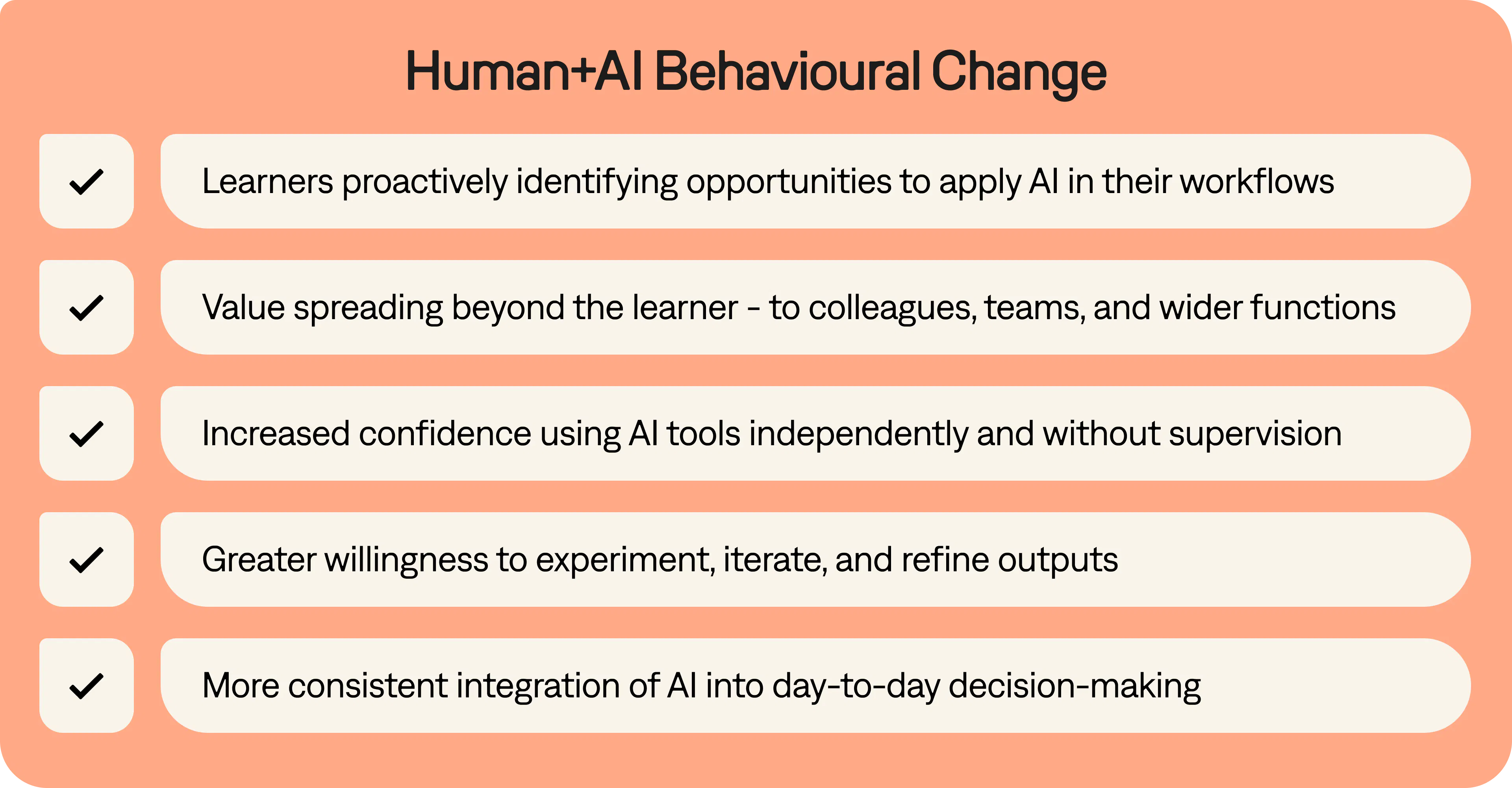
More fundamentally, behaviour change is a stronger predictor of lasting value than any individual project result. A one-off quantified result tells you something worked once. Embedded behaviour change – visible to managers, spreading across teams, becoming the new normal – tells you that value will keep compounding long after the programme ends or technology changes.
At Corndel, we anchor this Human+AI behaviour change in continuous application of learning at work. And we do not rely on individuals to report outcomes alone: every verified outcome is cross-referenced with independent line manager observation, coaches, or organisational data.
Adam identified inefficiencies caused by fragmented service request workflows across multiple teams, resulting in manual triage, duplication, and delays. He designed and implemented an AI-powered portal to automate request logging, introducing it iteratively with stakeholder feedback to refine functionality and align with existing systems. The result: £15,000–£20,000 in administrative cost savings in the first six months, with projected annual savings of £40,000.
3. Separate What Changed from What Would Have Happened Anyway
This is where many impact claims fall apart. AI adoption is rising across every sector. To credibly claim programme impact, providers need to demonstrate that change happened because of training – not just because technology is spreading.
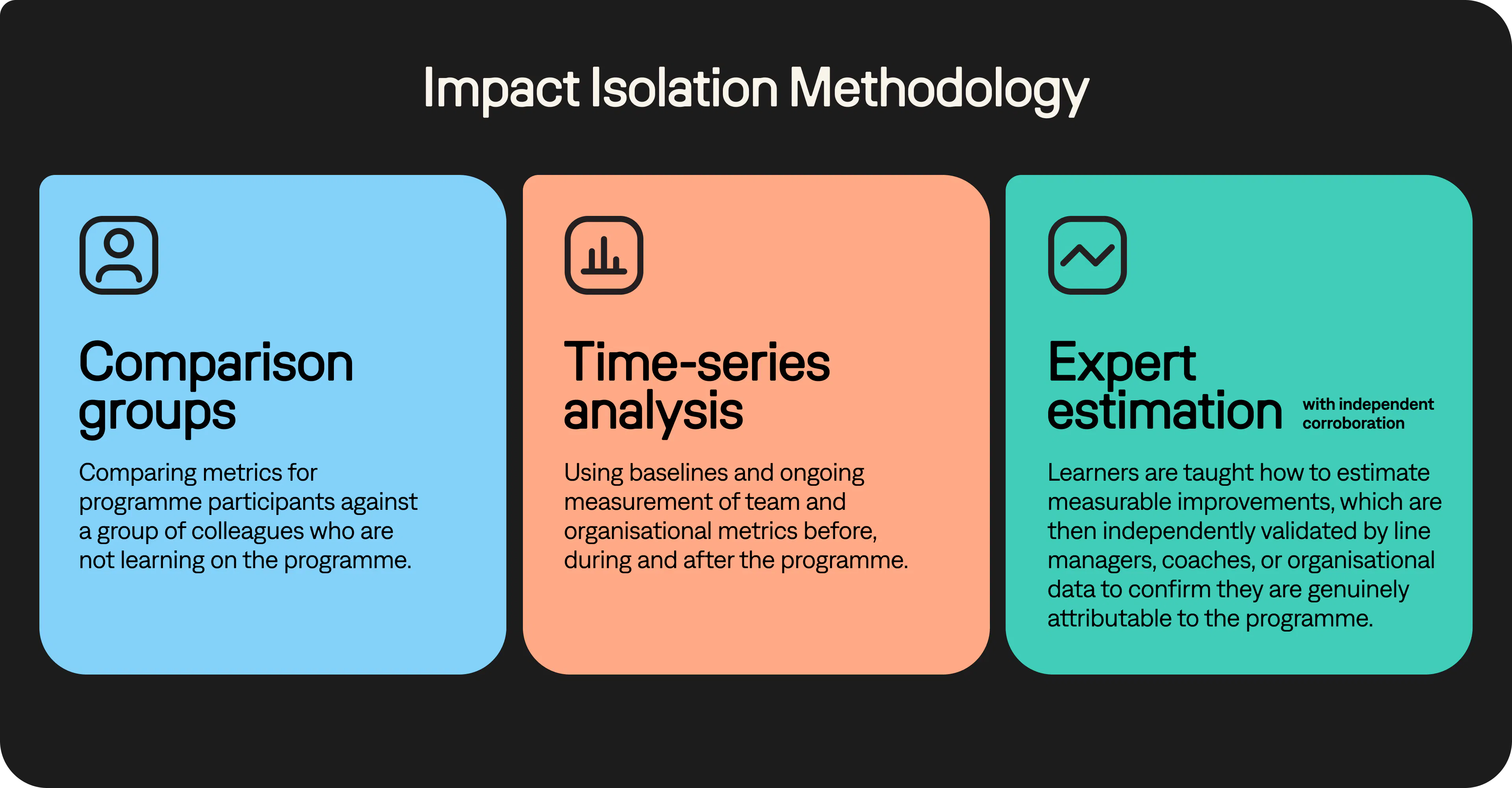
Corndel uses multiple impact isolation methods to support organisations to understand this distinction, and attribute learning to verified outcomes. Critically, we do not rely on individual estimation alone.
Every outcome should be cross-referenced with independent corroboration from managers, coaches, or system data. This distinction matters for employers who care about good evaluation practice.
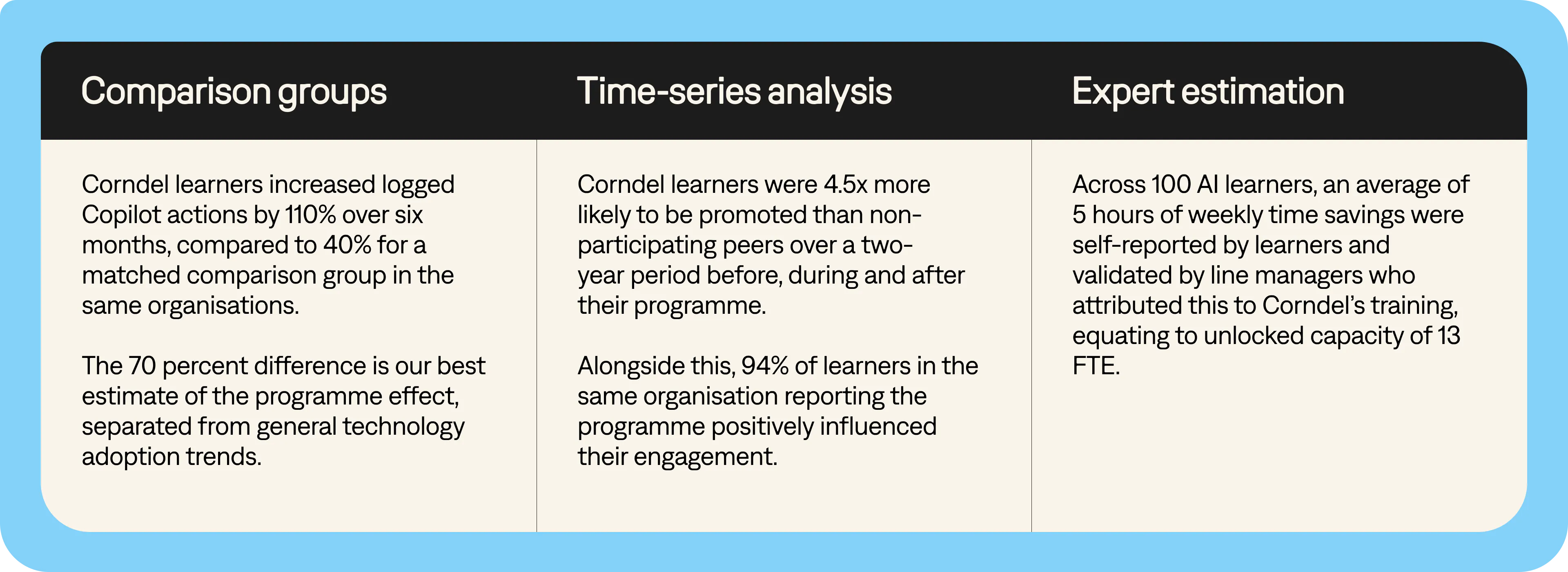
Examples of workplace transformation at organisations who upskill with Corndel:
The Questions You Should Be Asking AI training providers
Whether you work with Corndel or anyone else, these questions will help you to identify robust impact and training that really delivers:
- How is impact measurement designed before the programme starts?
If a provider only begins thinking about measurement once training is underway, you've already lost the baseline. The best providers co-design the evaluation with you before launch – agreeing which business outcomes matter, how they'll be measured, and what data sources you'll use together.
- When should I expect to see the first signs that training is working, and what will they look like?
Providers who only point to end-of-programme ROI figures haven't thought hard enough about what happens in between. Look for evidence of early behaviour change: are individuals applying new skills to real work within weeks? Can their managers see it? Early wins are both the first signal that something is working and the foundation for lasting value.
- How do you measure whether behaviour has actually changed in the workplace, not just what individuals report about themselves?
Individual self-assessment is only a starting point. A credible answer will describe independent line manager observation, 360-degree feedback, or system-level data that corroborates what individuals say about their own progress.
- How do you account for the fact that AI adoption is rising across every organisation, regardless of training?
If everyone's AI tool usage is going up, a provider's impact claim needs to show that trained employees are adding value faster than untrained colleagues in the same organisation – not just that change is happening.
- What proportion of individuals produce a financial return - and how do you report the ones who don't?
A single headline ROI figure conceals the distribution beneath it. Ask for the breakdown: what share of individuals generate a verified outcome, and how are non-completers handled in the data?
- What evidence do you have that impact is sustained after the programme ends? One-off project results are valuable. Sustained behaviour change – embedded new ways of working that persist and compound over time – is what creates lasting organisational value. Ask whether the provider has followed up with individuals and managers six months or a year after completion, and what those findings show.
- What does your independent satisfaction and achievement data look like – not your own surveys?
Any provider can design a survey or data collection that produces a high score. Ask specifically about third-party or government-published data. There is a material difference between self-reported satisfaction and external, independent ratings.